It’s been a long time coming. After eight years of researching, writing, and rewriting, and another four years seeking a publisher, my debut novel Line of Flight is publishing with Köehler Books on November 17. I still can’t quite believe it. Maybe when my advanced copies arrive in the next few weeks, it will finally feel real.
So it was quite fascinating and felicitous timing this past weekend to accidentally discover a printed copy of the first two original chapters of the novel, which I wrote sometime in 2014. Even more surprising, while tearing out some handwritten pages in a blank notebook that I was salvaging, I realized that several of the pages were actually the very first scene I had scribbled—quite a far cry from where I ended up.
What I find most interesting about these finds is how they actually contain seeds of the characters and my writing style that I honed over the next 12 years.
The handwritten scene is about Camilla, who is the daughter in Line of Flight, but in this initial attempt at putting a character down on paper, she is actually the mother of another spirited young woman named Janine. Camilla is struggling to write a tag line for a tea bag label, a freelance writing gig she has picked up, thinking it’s easy money, but that she finds to be nearly impossible. Janine is living in Tel Aviv during the 2014 war between Israel and Hamas, and she refuses to take air raids seriously. Camilla is terrified for her safety, but also knows that Janine will not speak to her if she pushes too hard. So she tries to comfort herself:
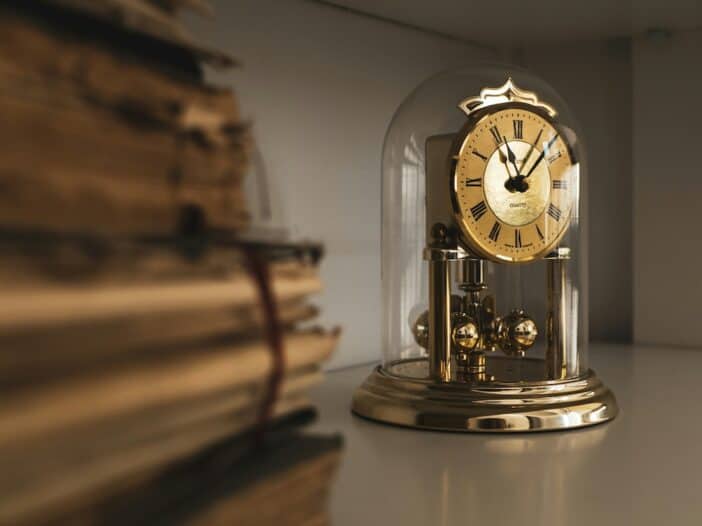
The cursor blinked, impatient, taunting. Camilla typed the numeral 1, followed by a right parenthesis. Then she deleted the parenthesis and typed a period. The anniversary clock that had once graced her Parisian grandparents’ mantelpiece chimed noon. Camilla typed:
You are stronger than you think.
Why a tea bag label? I can’t recall the exact connection, but at some point when I was picking names for my characters, I really liked the name Camilla, because it is associated with elegance and grace, but is also the name of a warrior maiden in Virgil’s Aeneid. And somewhere I read about a connection to tea, probably chamomile.
Here in this first stab at writing are also some key elements of the final novel: mother-daughter conflict over safety during a war, and a mother with Parisian roots who struggles with her own sense of agency.
The anniversary clock actually made it into a scene in Line of Flight, as well, though in a very different location and context. I had no idea until now that it had hovered in the back of my brain since I penned those first few paragraphs.
As for the printed copies of the original first two chapters, the story had significantly shifted by this point. I was writing in the late fall or early winter of 2014 and had established my characters here in Worcester, during World War I. Levitsky’s Dry Goods was set on Water Street, our city’s historic Jewish neighborhood, and Camilla was now the daughter of Mendl and Simone Levitsky. These details remain constant in the final novel, as does the tension between Camilla and Simone, with Mendl as their mediator.
However, in this early version, Camilla’s dream is to become a concert violinist, modeling herself after the career of Maud Powell, a child prodigy from Peru, Illinois, who studied in Europe and eventually played the first American performances of the Tchaikovsky and Sibelius Violin Concertos. In 1894, she performed Dvořák’s Violin Concerto with the New York Philharmonic in Carnegie Hall.
Camilla studies with one Grigory Cohn, practicing every morning at her parents’ dry goods store before they open for business, and surprises Cohn one day with the first movement of Mendelssohn’s Violin Concerto. (A little background here—I used to play violin and had worked my way up to Mendelssohn by my senior year in high school. It’s very hard.) But Cohn balks, because Mendelssohn was German and he won’t suffer any music by “a Hun” given how the war is going:
Why did his praise cast such a spell over her? Camilla dropped one of the paint brushes she had been hanging by size and type of bristle, and flushed, stooping to retrieve it. She had practiced so long and hard for those compliments, an hour every morning in the storage room, while Ta sipped his tea and read the newspapers before unlocking the storefront’s metal grates. Wednesday afternoon, that half-hour in Cohn’s Music Store, was her only escape from Worcester’s grime and Water Street’s gossip. Each week as she left her lesson, she always felt a step closer to her dream of becoming a concert violinist like the great Maud Powell.
Until today. How could she possibly audition at the Institute of Musical Art in New York City if she couldn’t play the Mendelssohn? It was the pinnacle of every violinist’s repertoire. Mr. Cohn had never questioned her aspirations before. You have a gift. Those were always his closing words as she paid him the three dollars Ta somehow managed to squirrel away from the store’s receipts each week.
To the best of my recollection (I seem to have lost the original electronic version of the first draft), Cohn is actually trying to manipulate Camilla into marrying him. She ends up at a fortune-teller’s apartment, following a pigeon to the door, and realizes her fate lies elsewhere. Somehow from there I was going to get her to France and volunteering in the ambulance corps. Yes, a bit of a stretch.
There’s a lot more in these first two chapters, but once again, what interests me is how it all filtered into the final version of the story. Here I alternated close third person point of view between Camilla and Simone, whose viewpoint dominates the second chapter. Their mother-daughter conflict is well established. I included some very specific details about the store, how the war was affecting prices, and other family dynamics between Simone and her in-laws. Much of that context—though not those specific details—is deeply woven into the final novel, although it is written in the first person from Simone’s point of view. It is her midlife coming-of-age story, rather than Camilla’s, although Camilla’s voice emerges in a series of letters within the novel. And, of course, there are pigeons.
All of this mucking around came to about twenty-thousand words by the end of 2014. Then I took a break. I wrote a short story called Nachtmusik about a British stretcher bearer who gets lost in No Man’s Land during the 1915 Battle of Loos, which eventually found a home in Chautauqua. That was my first taste of being a published fiction author.
By 2015, when I picked up the story again, I realized it had started in the wrong place. I had learned about the sinking of the Lusitania, and I knew that had to happen early in the narrative. And I kept on writing.
If you happen to live in or near Worcester, Mass., my book launch is on November 17, at 7:30 p.m., at the Museum of Worcester. I’ll be speaking about my research, reading a short excerpt, and signing copies. Hope to see you there!
Image: Jose P. Ortiz